
















Pressure Forces
All pipelines under pressure are subject to longitudinal forces, which tend to separate the component parts of the pipeline.
Longitudinal pressure forces acting on a blank end:
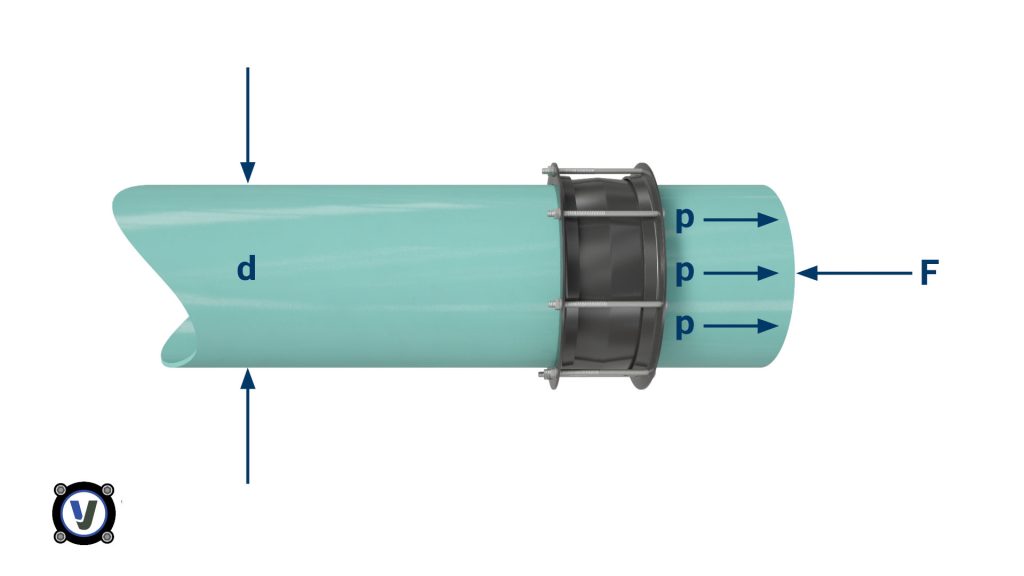
Consider the case of pressure acting on a blank end downstream of a flexible coupling. The force (F) necessary to prevent pipe separation is given by: –
Where d = pipe OD
p = internal pressure.
Example:
d = 508mm OD.
p = 16 bar = 1.6 N/mm2
Then F =
It is important to appreciate the magnitude of the end thrusts that can result from internal pressure in a pipeline. These longitudinal forces are particularly important in flexibly jointed pipelines, such as those jointed with Viking Johnson flexible products (e.g. Dedicated, QuickFit, MaxiFit and MegaFit). The pipeline designer must carefully consider not only the magnitude of these forces, but also the means of resisting them to prevent failure of the pipeline.
Pressure thrusts will be produced at all changes of direction, e.g. bends, tees, etc. and at cap ends, valves and reducers. Unless these thrusts are restrained locally at the point at which they are developed, pipe components may move under the load, leading to failure.
Longitudinal pressure forces acting at a bend:
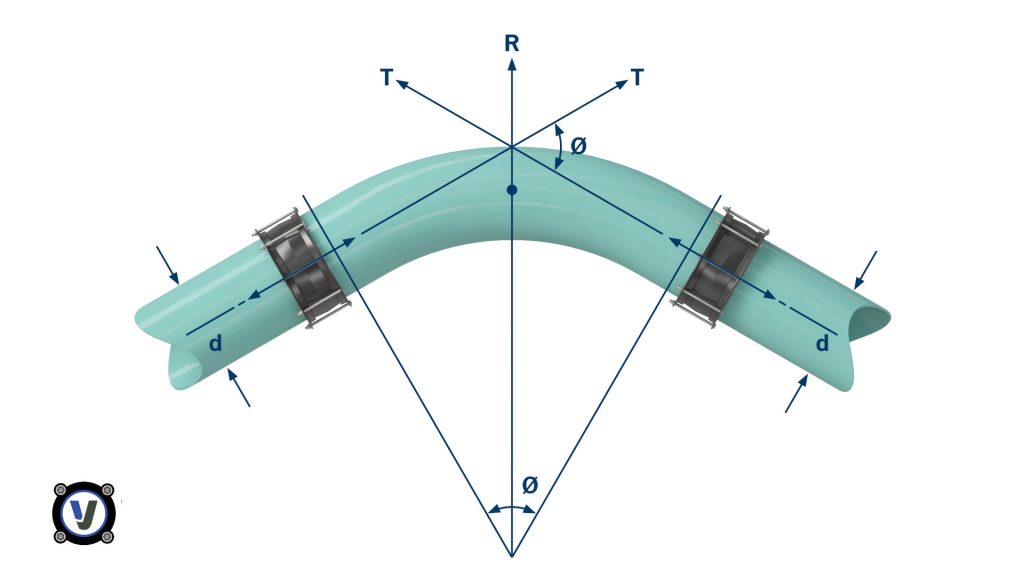
At a bend, there is a force (R), tending to push the bend outwards and there must be sufficient anchorage to resist resultant force (R).
where d = pipe outside diameter
p = internal pressure
and ø = angle of the bend
NOTE: Any consistent set of units is suitable.
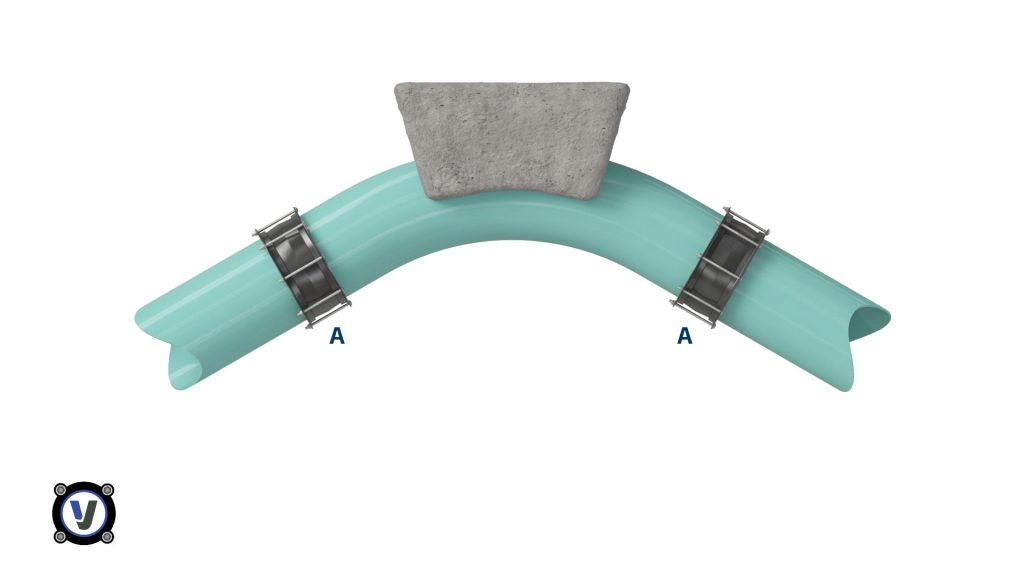
In a buried system a thrust block may be used to resist force (R).
Concrete thrust block to resist forces at a bend and prevent pipe pullout in the flexible couplings A:
Use of Restrained Couplings B at a bend to transfer force F into the straight pipe negating need for thrust block:
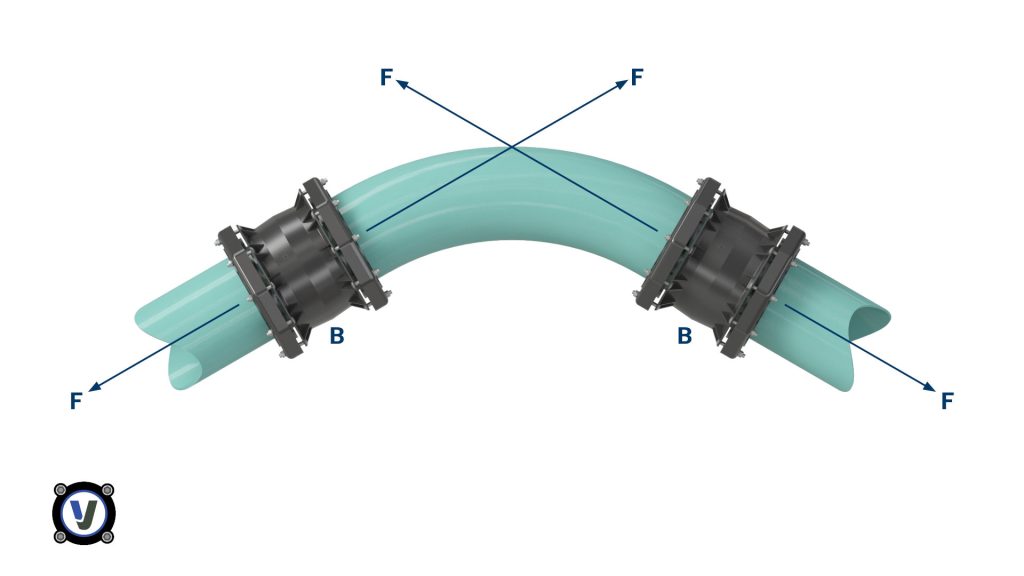
As an alternative to using a thrust block, flexible couplings “A” can be replaced with restrained fittings “B” that will transfer the force “F” from the bend and into the straight pipe section. So long as the straight lengths of pipework, or fittings etc. in these sections, can accommodate the force “F” then the thrust block can be omitted.
Even small diameter pipes may pull out of couplings at modest pressures unless proper external restraint is provided, especially if the pipe system is subjected to temperature or pressure fluctuations, vibration or external loadings.
With surface or above-ground pipelines it is generally necessary to take full account of the thrusts produced by internal pressures and to restrain them with thrust blocks, anchorages or tie bars.
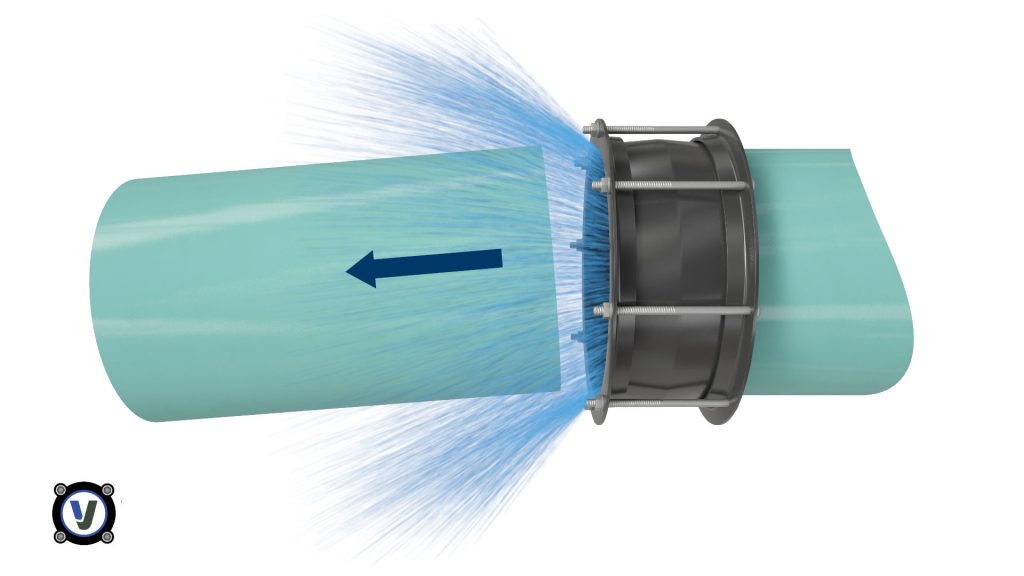
NOTE: Viking Johnson flexible couplings and reducing / stepped couplings do not resist longitudinal thrust loadings, and pipe pull-out will occur unless the loads are restrained by other means