
















Accommodating End Load – Restrained Fittings
Below ground, pipe thrusts can normally be restrained by means of concrete thrust blocks at bends, valves, etc. but above ground this is more difficult. In such circumstances it may be necessary to provide a harness assembly attached to the pipes.
Couplings
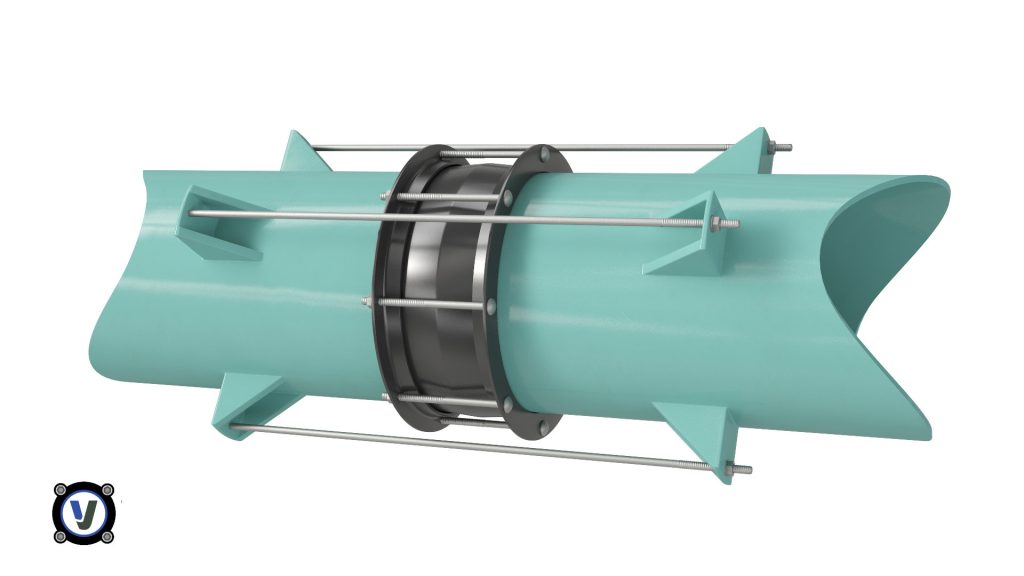
Accommodating pipe thrusts in above ground applications with Viking Johnson standard coupling products requires either external brackets / pipe supports or the use of harness assemblies attached to the pipe some distance back from each joint. Harness assemblies consist of one or more pairs of tie rods located in lugs / flanges welded to the pipe a short distance away from the joint. The design of the harness lug assembly must include for the transfer of end load forces via the tie rods into the pipe wall, and it is essential to verify that the interface between the lug and pipe wall is sufficiently strong enough to accommodate these loads. For this reason, Viking Johnson deem that the responsibility of the design for the harness lugs lies with the pipe manufacturer and therefore we cannot include these as part of our product offering. Use of a single pair of tie rods permits angularity between pipes in one plane, e.g. to permit ground settlement
Typical example of harness assembly for Viking Johnson couplings:
Flange Adaptors
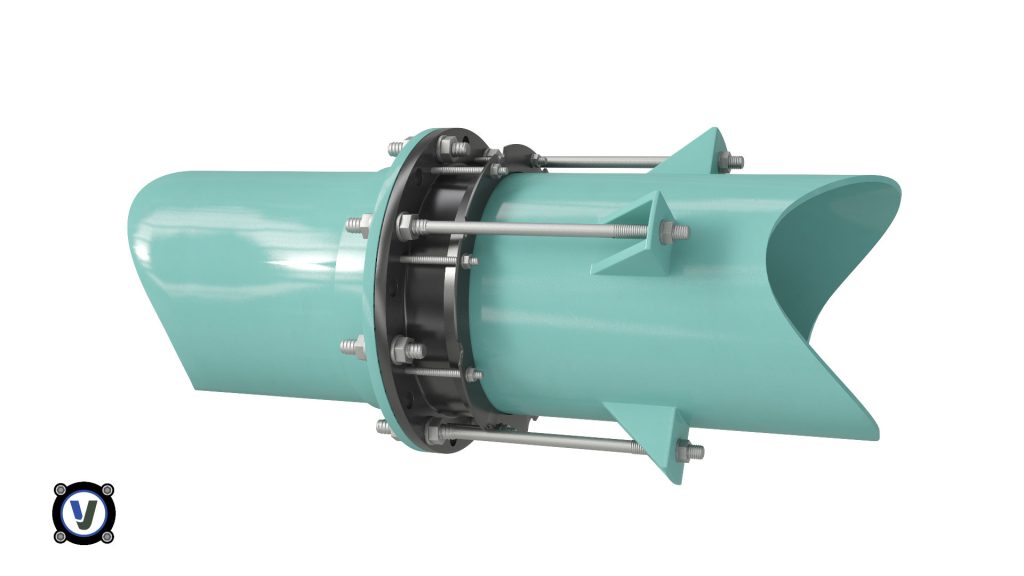
Flange adaptors can also be used with harness assembly, where several of the flange bolts are replaced with long tie bars. If a flange adaptor is to be used in a tied arrangement, depending on the pipe outside diameter and/or the flange drilling it may be necessary to notch the end ring to ensure sufficient clearance for the tie bars. If notified beforehand, Viking Johnson can incorporate notching of the end rings during manufacture.
As standard Viking Johnson will adopt the following rules for the number of notches in an end ring, and hence the number of tie rods required: –
When a flange adaptor is harnessed, there will be no resultant angular deflection, or in service expansion capability within the joint.
Typical example of harness assembly for Viking Johnson flange adaptors:
NOTE: Viking Johnson MaxiDaptor DN350 to DN600 cannot be notched.
Dismantling Joint
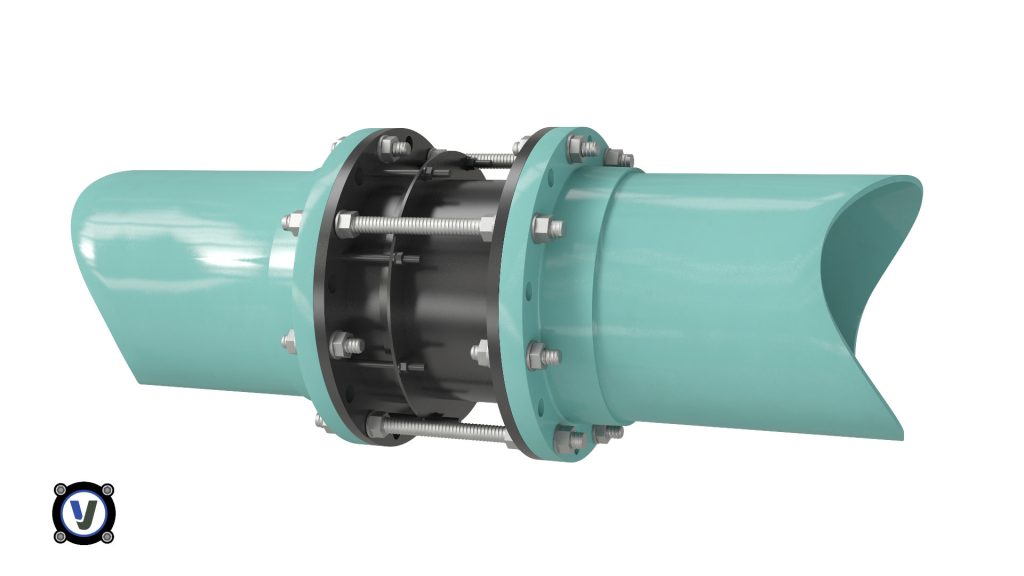
Harnessed flange adaptors used with a flanged spigot give a simple, cost-effective method of providing a demountable joint in an otherwise flanged system. Viking Johnson supply these as a complete package called a Dismantling Joint, where the standard product provides a cost-effective solution by offering the smallest flange / flange dimension. In the event longer dimensions are required to accommodate site situations these can be manufactured as bespoke fittings.
When a dismantling joint is harnessed, there will be no resultant angular deflection, or in service expansion capability within the joint.
Typical example of harness assembly for Viking Johnson dismantling Joint:

Alternative Viking Johnson Products
Viking Johnson has within its comprehensive range specialist products capable of accommodating end load forces, which include: –
- FlexLock: Dedicated flange adaptors and couplings for steel and ductile iron pipes.
- UltraGrip / Amplified UltraGrip: Wide tolerance couplings, flange adaptors, end caps and reducers for most pipe materials.


