
















Setting Gap
When Viking Johnson couplings are used to provide flexibility in pipelines they allow for pipe or ground movement during the life of the pipeline without leakage. However, such movement will result in relative longitudinal and/or angular displacement of the pipes within the coupling.
Under normal conditions, adjacent pipe ends should not contact each other in service. If there is insufficient gap so that pipes touch, the pipeline will tend to buckle as temperatures increase, or ground movement occurs and pipe end damage may occur. At the other extreme, if the pipe end gap is too large on installation, there is a risk that pipe movement may pull the end out past the gasket(s) of the coupling leading to leakage and failure of the pipeline.
To ensure that ensure that neither situation occurs, pipe end gaps are set within specified limits during installation of the coupling / flange adaptor and Viking Johnson provides maximum and minimum setting gaps or insertion depths for all their products: –
When couplings are specified with a locating plug, the Minimum Setting Gap should be increased by the diameter of the pin or plug (9.5mm or 12.7mm); the Maximum Permissible Gap should not be increased.
Setting gaps are a function of coupling / flange adaptor sleeve length and pipe diameter, with all Viking Johnson data sheets providing details.
Above Ground Pipework
For pipes above ground, it is possible for unanchored pipes to shunt together after installation, opening a large gap between pipes at certain points. Such pipe movement must be controlled to ensure that the Maximum Setting Gap is not exceeded, or there may be a risk of the pipe pulling out of the coupling. Soil friction acting on pipes laid below ground normally prevents any such pipe shunting movement.
The Maximum Setting Gap, measured on the centreline, should not be exceeded in service. Consideration of actual thermal movement or deflection conditions may lead to different initial setting gaps.
Checking Potential Pipe Movement does not Exceed Maximum Setting Gap:
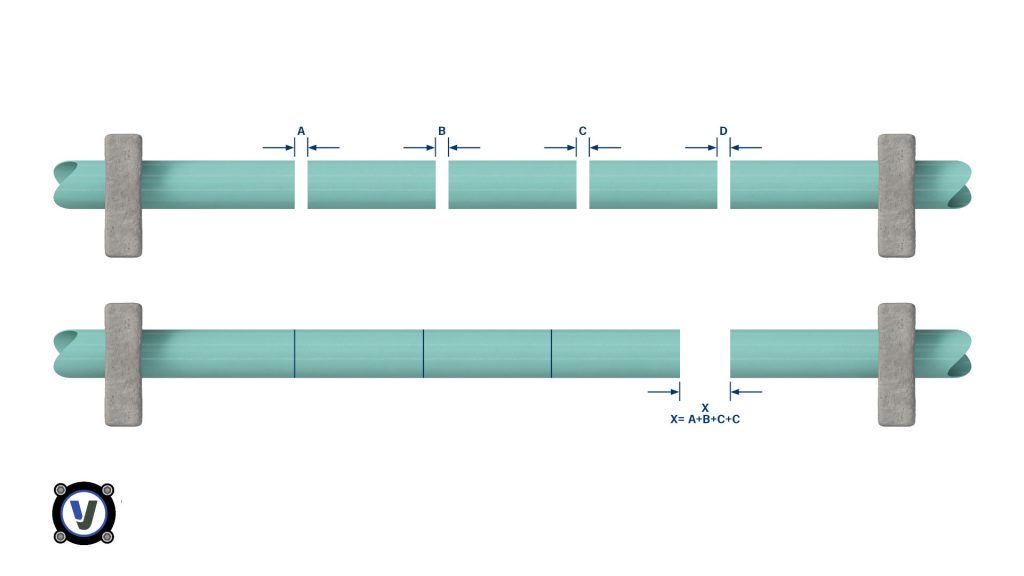
- Pipes laid straight with equal setting gaps.
- Accumulated gap (X) on straight pipeline must not exceed maximum permissible value given in Data Sheet
Where the standard Viking Johnson sleeve length is found to be insufficient, longer sleeved couplings and flange adaptors can be supplied.
See section on “Locating Plugs” as these are also used for above ground pipework.