















Inclined Pipelines
Where Viking Johnson dedicated couplings are to be installed in pipelines laid on significant slopes, it is important to consider the restraint of the component of self-weight acting parallel to the axis of the pipeline, to stop the pipe sliding down the slope.
Below ground pipelines will receive significant restraint from backfill loading and therefore less extra axial restraint will be necessary than for above ground pipelines, but the gravity forces still need to be considered in a proper engineering assessment of the design. On above ground pipelines the Viking Johnson couplings should be fitted with locating plugs to ensure the coupling’s location relative to the pipe ends.
NOTE: Locating plugs are not designed to restrain pipe self-weight, axial forces or other pipeline thrusts, only to restrain the coupling itself, i.e. the pipes must be fixed.
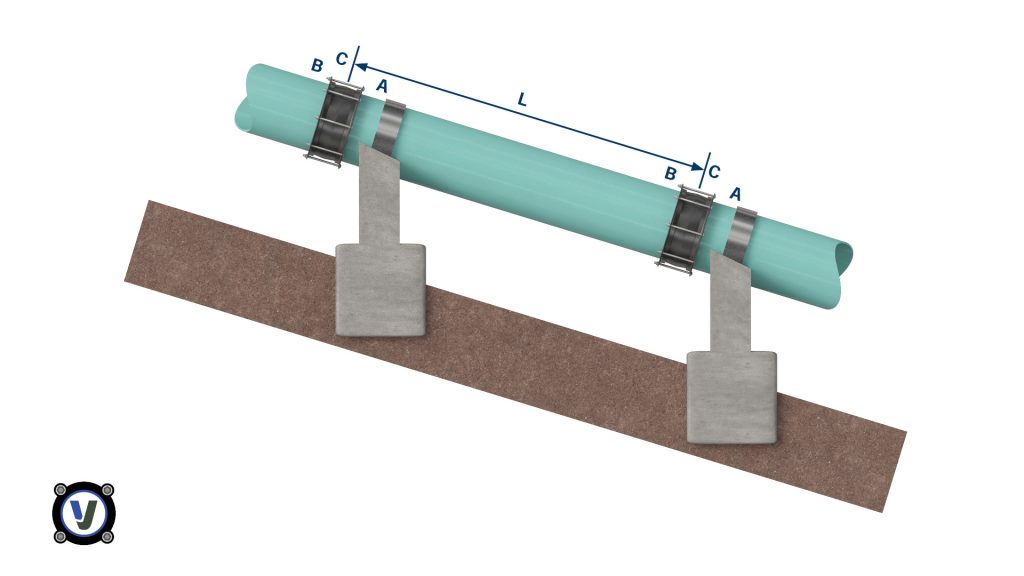
Where the length L of pipe to be supported by the Viking Johnson couplings does not exceed 10 metres, it is normally desirable to anchor one end, A, of each pipe in position relative to the ground, allowing the other end, B, to be supported by coupling C and to move axially with temperature fluctuations as shown. Its limitations are detailed in Expansion and Contraction.
Pipeline anchorage must be designed to restrain all axial forces due to self-weight, fluid friction and pressure. The pipe support design will be determined by pipe diameter, pressure, wall thickness, pipe inclination to horizontal, etc. and is beyond the scope of this guidance. Certain diameter, pipe length and inclination conditions may necessitate the use of supports on both sides of the coupling. In this instance one support should be fixed, the other sliding to permit thermal movement. It is essential that accurate pipe alignment is observed to prevent excessive shear stress in the coupling.
Typical support of inclined pipelines: